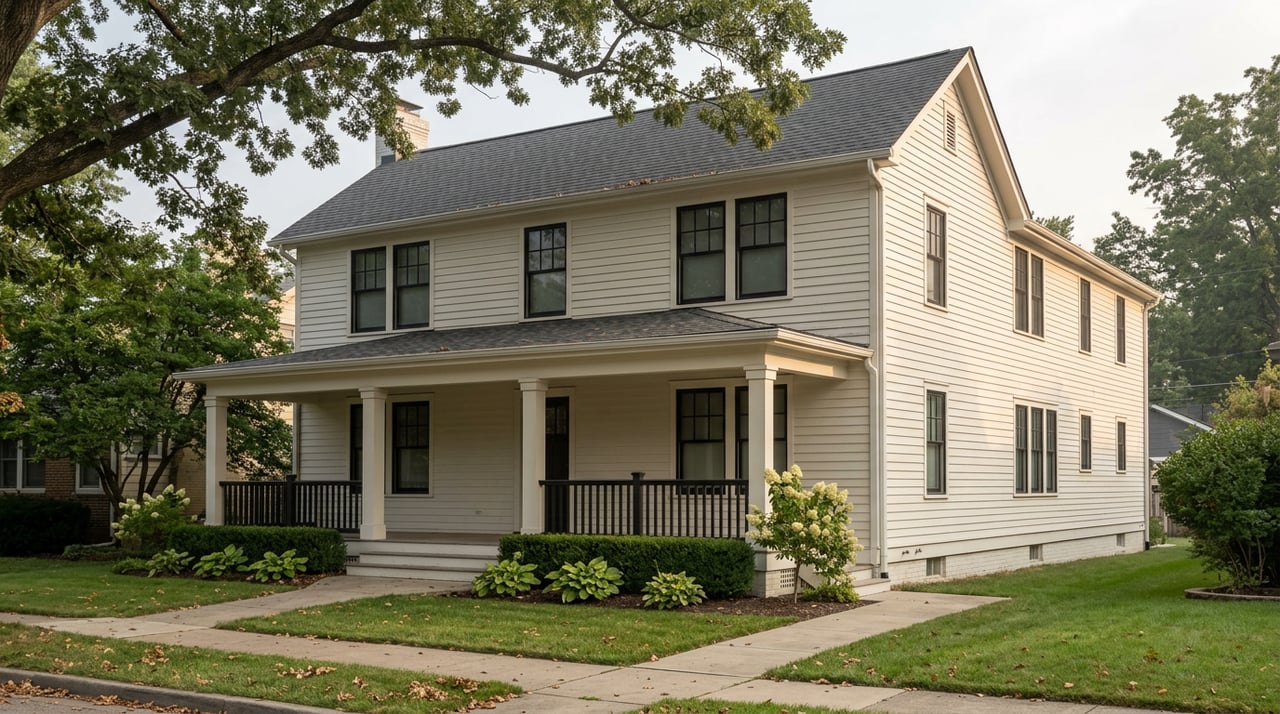
Say you're looking at a hundred-year-old two-story in the Washington Neighborhood. The bones are good, the price per square foot beats anything comparable west of downtown, and you've heard from a neighbor, a contractor, maybe an old blog post, that Dubuque has a program that erases the tax hit when you fix the place up. You pencil that into your renovation budget as close to a wash. It isn't anymore, and the gap between what people assume and what the ordinance actually pays has gotten wide enough to change the math on a fixer-upper in Dubuque's older core.
What the exemption actually covers now
Dubuque's Urban Revitalization Program has been around since the 1980s, built to encourage owners in designated older neighborhoods to reinvest rather than let buildings age past the point of repair. The City of Dubuque says the mechanics are straightforward: if you improve a residential property inside a designated district and the work increases the assessed value of the structure by 10% or more, the city exempts a portion of the property tax on that increase for 10 years. Commercial projects need a 15% bump. The threshold is measured against the existing building's assessed value, not the land
For years, that exemption covered something close to the full tax increase. That's no longer true. In 2024, the state changed how the exemption is calculated, carving the school tax levy out of what can be abated. Applicants now only get relief on the portion of their tax bill that isn't earmarked for schools. For improvements completed in 2025, the city puts the effective exemption rate at roughly 57%. Renovate a home, trigger a 10% jump in assessed value, and you're now paying property tax on the other 43% of that increase for the next decade, not none of it.
The floor keeps moving
A 57% exemption on a fixed tax rate is one thing. A 57% exemption amid tax pressures on several fronts is a different calculation entirely, and that's the position Dubuque renovators are actually in this year.
The City Council voted in March 2026 to raise its base property tax rate for fiscal year 2027, from $10.06 to $10.16 per $1,000 of taxable value, adding roughly $27 a year to the average homeowner's city tax bill. Separately, the Dubuque Community School District held its September 8, 2026 special election on a measure asking voters to double the Physical Plant and Equipment Levy from 67 cents to $1.34 per $1,000 of assessed value, a change the district said was needed to keep pace with rising costs for things like roof repairs and bus replacements. And in May 2026, Governor Kim Reynolds signed a new state law capping annual local government revenue growth at 2%, a change city finance officials estimate could strip roughly $220 million in taxable value from Dubuque's tax base.
As reported by KCRG, City CFO Jennifer Larson put the tension plainly in a council presentation on the new state cap:
"If inflation is higher than 2%, we could see our costs rising higher than what we can raise the General Fund levy."
None of these three developments is the Urban Revitalization Program itself, but together they add uncertainty to the tax picture surrounding it. A shrinking exemption percentage, alongside changing tax rules and rates, means the real-dollar value of the tax break on a given renovation can keep eroding. If you're comparing a fixer-upper's carrying costs today against numbers a friend quoted you two or three years ago, you're not comparing the same program.
Two incentive systems, not one
Part of the confusion around this program comes from the fact that Dubuque runs more than one kind of tax incentive for older buildings, and they behave nothing alike. The Urban Revitalization exemption applies inside specific designated districts like the Washington Neighborhood. The Historic Millwork District, by contrast, has been rebuilt almost entirely through tax increment financing, a much larger and more developer-facing mechanism.
| Urban Revitalization Exemption | Millwork District TIF | |
|---|---|---|
| Focus | Residential property improvements | Developers converting industrial buildings |
| What it does | Exempts a share of the tax increase from improvements | Rebates future tax revenue to fund upfront construction costs |
| Typical scale | Single property, 10-year exemption | Multi-million dollar projects, city-negotiated agreements |
| Recent example | 57% exemption rate on 2025 improvements | $1.4 million in city support approved for 34 Novelty Iron Works condos in January 2026 |
| Cumulative activity | Roughly a dozen to 20 applications a year citywide, historically | $34.5 million in TIF financing on 60 housing projects since 2010, leveraging $326 million in private investment |
If you're weighing a single-family renovation in the Washington Neighborhood or North End against a loft purchase in the Millwork District, you're not choosing between two versions of the same deal. You're choosing between a modest, owner-side tax exemption and a much larger, developer-negotiated financing structure that already priced its incentives into the building before you ever saw the listing.
What this means depending on where you're looking
If you're eyeing an older home in one of Dubuque's designated revitalization districts with plans to renovate, the exemption is still worth claiming. It's real money, even at 57%. But it should be treated as a partial offset in your renovation budget, not a wash. Run the math on the actual dollar exemption at current rates, not at the rate a neighbor or a contractor might describe from before 2024.
If you're looking at a converted loft in the Millwork District, like the ones in the CARADCO or Novelty Iron Works buildings, the incentive story already played out in the building's development cost. That's a different kind of value proposition, tied more to the developer's negotiated TIF deal than to anything you'll apply for yourself.
And if you're comparing either option against a newer build elsewhere in the county, remember that Dubuque's citywide market itself has been fairly steady. The median sale price in the city of Dubuque sat at $242,000 over the three months ending June 2026, up just 0.8% from the same period a year earlier, with homes averaging $142 per square foot. That's a market that isn't moving dramatically on its own. The renovation tax picture inside the historic core is where the real variability is right now, and it's the kind of variability that shows up on your tax bill years after closing, not on the listing sheet.
One more detail worth knowing before you apply: applications for a given year's improvements are due by February 1 of the following year. For work completed in 2026, that means a February 1, 2027 deadline, filed with the city's Housing and Community Development Department.
A couple of things worth settling before you make an offer
Does the exemption apply outside city limits? No. It's a City of Dubuque program tied to specific designated revitalization districts inside the city, not a county-wide benefit.
Does a smaller kitchen remodel qualify? Only if the improvement pushes the structure's assessed value up by at least 10%. Smaller cosmetic projects that don't clear that threshold don't trigger the exemption at all, so it's worth getting a rough valuation estimate from the county assessor before you commit to a scope of work.
Older homes in Dubuque's historic neighborhoods still carry real advantages: character, walkability, and price points that newer construction in the county can't match. The tax incentive built to encourage their renovation just doesn't cover what it used to, and the rates it's measured against are still moving. If you're weighing one of these properties, run the numbers as they stand today, not as they stood before the rules changed.
If you're comparing a renovation project in Dubuque's older neighborhoods against new construction elsewhere in the tri-state area, Bowen Conlon Real Estate can walk through what a specific property's tax and incentive picture actually looks like before you write an offer. Get Your Free Home Valuation to start the conversation.
This article is general information, not legal, tax or financial advice. Consult a qualified professional about your situation.